Hedges · 9 min read
When and How to Prune Wisteria: The Complete Two-Cut Guide
By House of Horticulturists · 2 October 2026
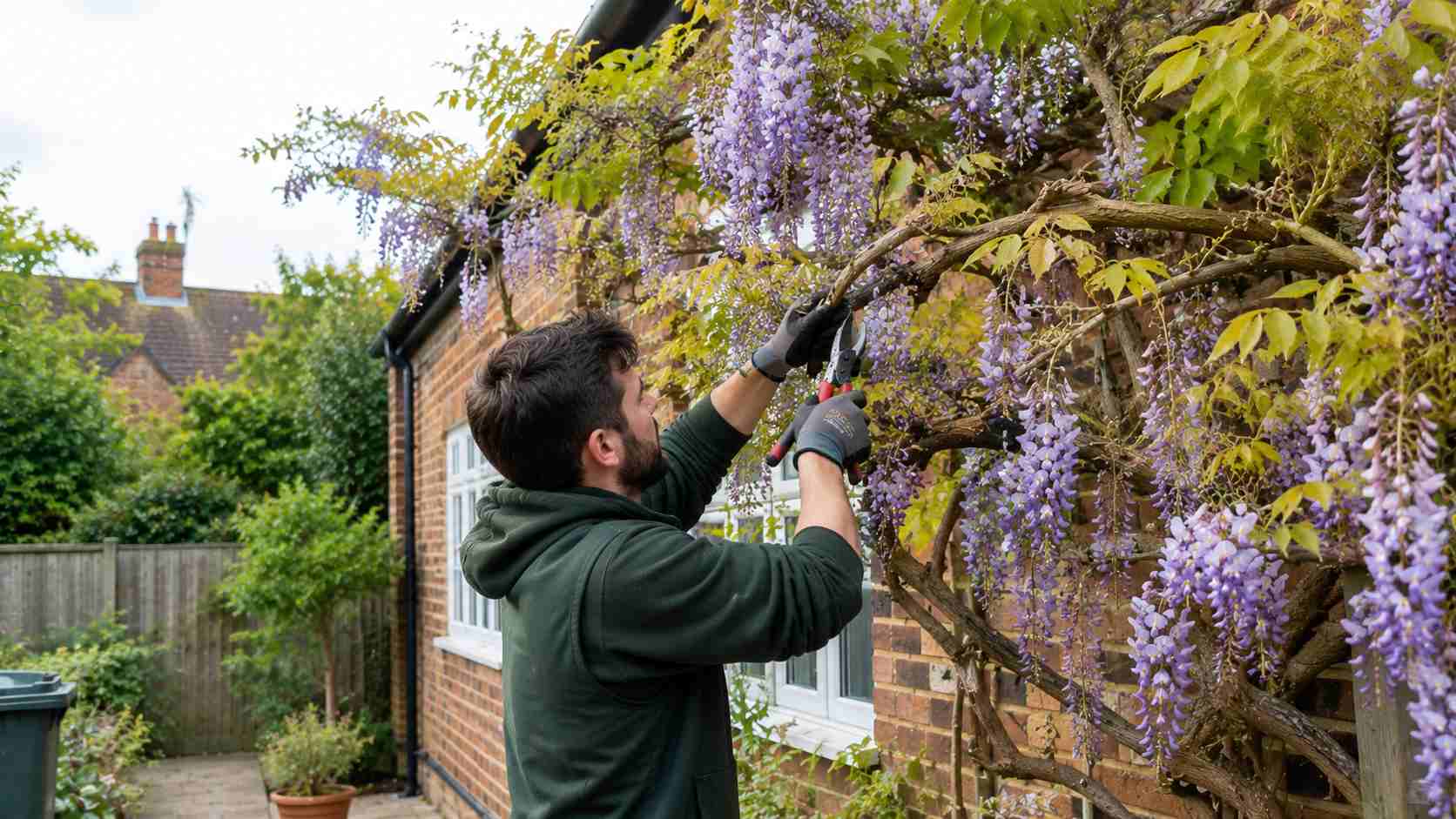
Few garden complaints come up as often as a wisteria that grows vigorously but refuses to flower, and in the vast majority of cases, the cause is pruning, either the wrong timing, the wrong technique, or simply none at all. Wisteria is pruned twice a year, once in summer and once in winter, a system specifically designed to control its famously vigorous growth while encouraging the flowering spurs that produce next spring's display. Get the two-cut method right and an established wisteria rewards you with one of the most spectacular flowering displays available in a UK garden.
Why wisteria needs pruning twice a year
Left unpruned, wisteria puts almost all its energy into long, whippy vegetative growth rather than the short, stubby flowering spurs that actually produce blooms, which is exactly why an unpruned or poorly pruned wisteria can grow enormously while flowering poorly or not at all. The two-cut system exists specifically to redirect that energy, checking the vigorous summer growth and then, in winter, cutting back further to encourage the plant to form flower buds rather than more leafy growth.
It's also simply a matter of control, wisteria is an extremely vigorous climber, capable of extending several metres in a single growing season, and without regular pruning it quickly outgrows its support, invades guttering, and becomes a tangled, unmanageable mass that's far harder to bring back under control than to maintain properly from the start.
The summer prune: July to August
The first cut comes in mid to late summer, once the long, whippy green shoots produced that season have finished extending. Each of these new shoots should be cut back to around five or six leaves from the main framework, removing the excess length while leaving enough growth for the plant to continue photosynthesising and build energy for the following season.
This summer cut serves two purposes, it keeps the plant visually tidy and prevents it from swamping its support or nearby plants through the rest of the growing season, and it begins the process of encouraging the plant to put energy into flower bud formation rather than continued leafy extension growth.
The winter prune: January to February
The second cut comes in deep winter, while the plant is fully dormant and the framework is clearly visible without leaves in the way. The same shoots that were cut back in summer are pruned again, this time more severely, back to just two or three buds from the main framework. These short spurs are exactly where the following spring's flowers will form.
This winter cut is what really concentrates the plant's energy into flower production, and it's often the step that gets skipped or done too lightly, leaving shoots longer than they should be and the resulting display noticeably weaker than a properly double-pruned plant would produce.
A step-by-step summary of the two-cut method
- ›In mid to late summer, once new whippy growth has finished extending, cut each new shoot back to five or six leaves from the main framework.
- ›In January or February, while the plant is dormant, cut the same shoots back further, to two or three buds from the framework.
- ›Remove any growth that's reaching into guttering, windows, roof tiles or neighbouring plants at either pruning session, regardless of the general spur-forming technique.
- ›Keep an eye on the main framework through both sessions, removing any crossing, damaged or awkwardly placed branches to maintain a clean, well-structured shape.
- ›Repeat this cycle every year, it's not a one-off job, consistent annual pruning is what produces a strong, reliable flowering display over time.
Training a young wisteria
A newly planted wisteria needs a slightly different approach in its first few years, focused on establishing a strong main framework rather than encouraging flowering spurs immediately. Select and train one or two main leading stems along the desired support, tying them in regularly as they extend, and prune back side shoots to encourage the main framework to thicken and extend in the right direction.
Flowering spurs can be encouraged once this framework is well established, typically from the second or third year onward, at which point the standard two-cut method can be applied to side growth while the main leaders continue extending to fill the available support.
Why a wisteria might not be flowering
- ›Insufficient sun, wisteria flowers best with a good amount of direct sun, often struggling in heavy shade regardless of pruning.
- ›Missing or incomplete winter pruning, the step most commonly skipped, leaving spurs too long to flower reliably.
- ›Pruning at the wrong time, cutting hard in spring can remove the flower buds that were about to open.
- ›A young plant simply not yet mature enough, wisteria grown from seed in particular can take several years before flowering begins regardless of care.
- ›Overfeeding with high-nitrogen fertiliser, which encourages leafy growth at the expense of flowers, a phosphorus-rich feed suits wisteria better.
Renovating a neglected or overgrown wisteria
A wisteria that's been left unpruned for several years can look genuinely daunting, a tangled mass of old growth with little obvious structure. The good news is that wisteria generally tolerates hard renovation pruning well, since it's such a vigorous grower, though bringing an overgrown plant back under control is usually better done gradually over a couple of seasons rather than cutting everything back severely in one go, which can shock the plant and set flowering back further.
Start by identifying and retaining a strong main framework, removing excess growth back toward this structure, then apply the standard two-cut method going forward once the framework is clear and manageable again. For a genuinely overgrown or structurally complicated wisteria, particularly one that's grown into guttering, roof tiles or a neighbouring property, it's often worth having the renovation assessed properly before starting, since poor cuts on old wood can set a plant back considerably.
Tools and technique
A good pair of clean, sharp secateurs handles most of the summer and winter pruning, with loppers useful for thicker, older framework growth during a renovation or when removing larger unwanted branches. Clean cuts heal faster and reduce the risk of disease entering the plant, so it's worth taking the time to keep blades sharp rather than tearing through growth with blunt tools.
For wisteria trained on a pergola, wall or large structure, safe access matters as much as technique, a sturdy ladder or appropriate access equipment is worth having in place before starting, since reaching awkwardly for high growth is both inefficient and genuinely risky.
Getting wisteria pruning right year after year
The two-cut method is simple in principle but easy to let slip, particularly the winter prune, which often gets missed in the busier summer gardening season's shadow. Building it into an annual routine, alongside other structured pruning jobs like those covered in our guide to what to prune in August and September, keeps an established wisteria flowering reliably year after year rather than drifting into the overgrown, under-flowering state so many established plants end up in.
Our Hedges, Pruning & Planting service handles structured pruning for wisteria and other established climbers, including both the summer and winter cuts on the correct schedule, and for anyone wanting this built into a wider annual garden routine, our Garden Maintenance plans can schedule seasonal pruning jobs like this automatically. This applies to established wisteria in gardens across Cobham and Weybridge alike, the technique is identical regardless of setting, what varies is simply how established and how overgrown a particular plant has become.
Frequently asked questions
This is almost always a pruning issue, commonly a missing or incomplete winter prune, which leaves flowering spurs too long to bloom reliably. Insufficient sun, a young plant not yet mature, or overfeeding with high-nitrogen fertiliser can also be factors.