Driveways · 10 min read
Choosing a Driveway Surface: Block Paving, Gravel or Resin?
By House of Horticulturists · 7 August 2026
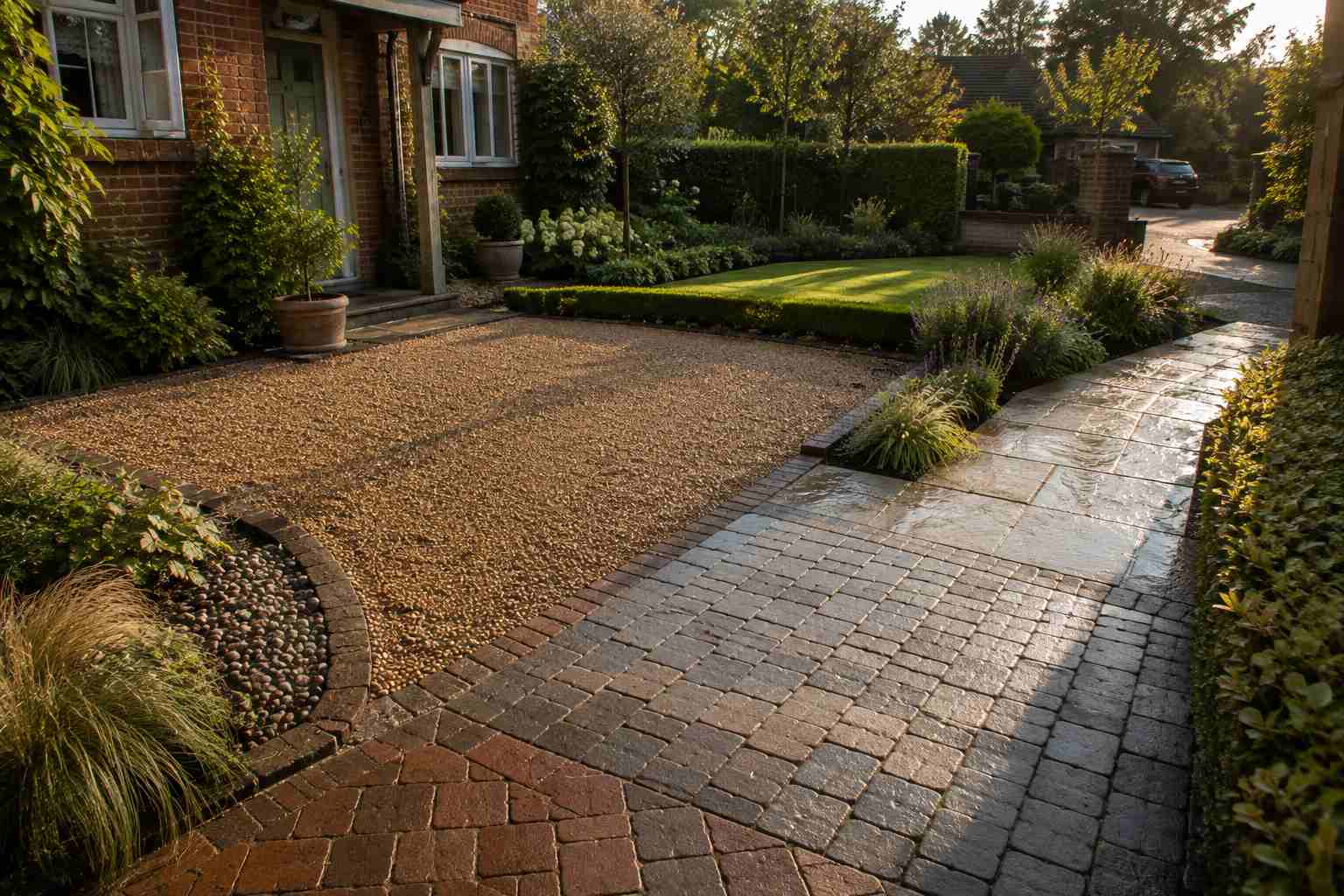
When it comes to driveways and paths, three surfaces dominate the market: block paving, gravel and resin-bound. They look different, cost differently, and behave very differently once they're down for a few years, which is why the right choice really depends on your priorities rather than there being one universally best option. Choosing well means weighing durability, drainage, ongoing maintenance, budget and the finished look you're after, and getting it right upfront saves a costly resurfacing job a few years down the line.
Block paving
Block paving remains the most popular choice for good reason. It's hard-wearing, available in a huge range of colours, textures and laying patterns, and it handles vehicle weight well when laid on a properly constructed base. One genuine practical advantage over resin or tarmac is that individual blocks can be lifted and re-laid if you ever need access to services running underneath the drive, something that's simply not possible with a bonded surface.
The main ongoing upkeep is keeping weeds and moss out of the joints and occasionally re-sanding them as jointing sand washes out over time. Done every couple of years, this keeps a block-paved drive looking sharp for decades. Block paving does carry a higher upfront cost than gravel, but its durability and the fact that damaged sections can be repaired individually rather than resurfaced entirely make it a strong long-term investment.
Gravel
Gravel is the most budget-friendly of the three options and remains genuinely popular, particularly on period or rural-style properties where a more formal surface would look out of place. It's naturally free-draining, gives a relaxed, traditional look, and doubles as a quiet security feature since footsteps and tyres are audible across it.
The downsides are practical rather than aesthetic: loose gravel migrates over time, particularly on slopes or wherever cars turn sharply, and it needs occasional topping up as stones scatter onto verges or get walked into the house. A stabilising grid laid beneath the gravel largely solves the migration problem, keeping stones locked in place while still allowing full drainage, and it's a detail worth insisting on rather than treating as optional.
Resin-bound
Resin-bound surfacing gives a smooth, seamless, contemporary finish with no loose stones to scatter or migrate, which is a large part of its appeal for modern-build homes and anyone wanting a driveway that reads as neat and low-maintenance. Laid correctly as a permeable system over the right sub-base, it also lets rainwater drain straight through rather than running off the surface.
It sits at the higher end of the cost scale, and results depend heavily on correct installation, resin-bound surfaces that fail prematurely have almost always been laid too thin, mixed incorrectly, or put down on an inadequate base rather than being a fault of the material itself. Choosing an experienced installer matters more with resin than with either of the other two options.
How to choose based on what matters most to you
- ›Lowest upfront cost: gravel is generally the cheapest option to install.
- ›Lowest long-term maintenance: resin-bound needs the least routine attention once properly laid.
- ›Best for heavy, regular vehicle use: block paving copes best with repeated weight and turning wheels over many years.
- ›Best drainage without extra design work: gravel and permeable resin-bound both handle rainwater well by design.
- ›Easiest to repair or adapt later: block paving wins here, since individual blocks lift and relay cleanly.
- ›Best for a period or rural property: gravel usually suits the character better than a hard, uniform surface.
- ›Best for a clean, modern look: resin-bound gives the most contemporary, uniform finish.
Comparing cost and lifespan
As a general rule, gravel costs the least to install but can need topping up every few years and doesn't add the same kerb appeal as a hard surface. Block paving costs more upfront but, laid on a proper base, will comfortably last several decades with only minor, cheap maintenance. Resin-bound sits above block paving in initial cost, and its lifespan is heavily dependent on installation quality, a well-laid resin drive can also last decades, while a poorly laid one can fail within a few years.
It's worth thinking about total cost over 15 to 20 years rather than just the initial quote, a cheaper surface that needs replacing twice can easily end up costing more than a well-installed premium surface that only needs light upkeep.
Don't forget the drainage rules
Surfacing a front garden in England comes with rules around rainwater run-off. Broadly, an impermeable surface over a certain area that drains toward the road can require planning permission, while permeable surfaces, or drainage designed to a soakaway or border, generally don't. The specific rules and thresholds can change, so it's worth verifying the current requirements before committing to a design rather than assuming your neighbour's driveway sets the precedent.
Designing drainage in from the start, not bolting it on afterward, is a core part of how we approach patio and paving work, and it's far cheaper to plan correctly at the outset than to retrofit drainage into a finished surface.
The base does the hard work
With all three surfaces, it's the preparation underneath that actually determines how long the drive lasts, not the surface material itself. That means excavation to the right depth, a properly compacted sub-base suited to the ground conditions and expected vehicle weight, and correctly installed edge restraints to stop the whole surface spreading or sinking at the margins over time.
It's the same principle that runs through everything in landscaping, the parts you never see once the job is finished are usually what decide whether it still looks good in ten years. A smart new drive is also one of the best kerb-appeal upgrades a property can have, something we see making a genuine difference to homes around Kingston and Kensington, where period and detached properties both benefit from a well-specified new surface.
Common driveway mistakes to avoid
- ›Skimping on the sub-base to save money, this is the single biggest cause of driveways that crack, sink or rut within a few years.
- ›Ignoring drainage requirements and rules, leading to run-off problems, standing water, or work that falls foul of planning rules after the fact.
- ›Choosing resin-bound on the cheapest quote available, poor installation is the main cause of resin surfaces failing early.
- ›Leaving gravel unstabilised on a sloped or heavily used drive, guaranteeing ongoing scatter and top-up costs.
- ›Picking a surface purely on look without considering how the household actually uses the drive, heavy vehicles, multiple cars, or a steep slope all change which surface makes sense.
Frequently asked questions
Gravel is usually the lowest-cost option and drains well, though it needs occasional raking and topping up. Block paving and resin-bound cost more up front but need less routine attention over their lifespan.